The Short Answer: 2026 Price Ranges
These are broad Australian market ranges for 2026. Treat them as a starting point — hail quotes move with the number of dents, their depth, and above all whether the paint surface survived. A proper price needs an inspection, which is why our hail damage repair assessments are written, photographed and free of obligation.
| Job | Typical range (AU) |
|---|---|
| Single small dent, paint intact (PDR) | $100 – $250 |
| Lightly hailed panel, paint intact (PDR) | $150 – $400 |
| Whole car, light–moderate hail (PDR) | $2,000 – $5,000 |
| Panel repair + refinish (paint damaged) | $400 – $1,200 per panel |
| Panel replacement + paint (roof skin, bonnet) | $800 – $2,500+ per panel |
| Widespread severe hail, conventional repair | $6,000 – $15,000+ |
Two cars parked side by side in the same storm can land at opposite ends of that table. The difference usually isn't the number of dents — it's what happened to the paint.
The Paint Is the Fork in the Road
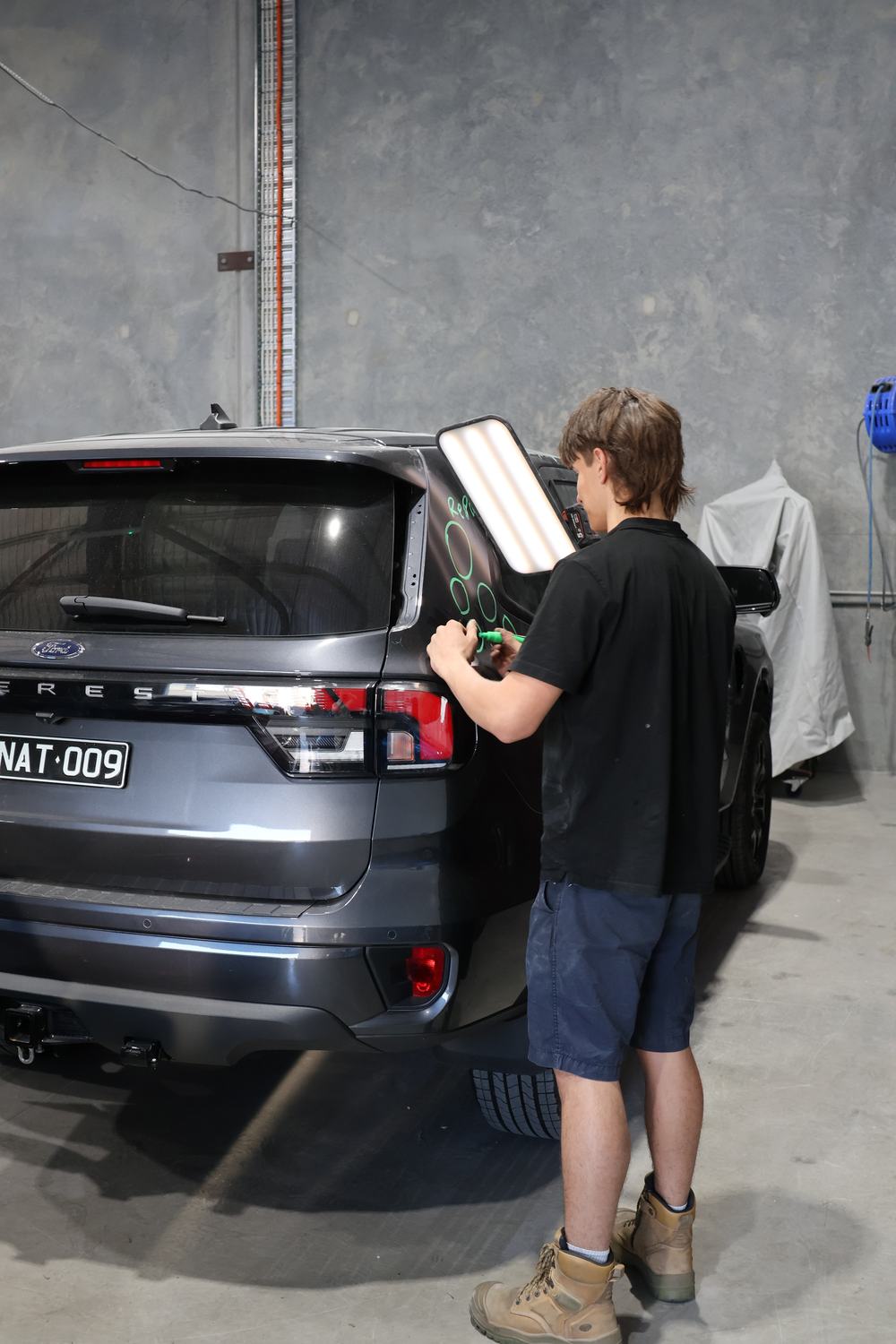
Hail repair splits into two trades. Paintless dent repair (PDR) massages shallow dents out from behind the panel without touching the paint — it's fast, comparatively cheap, and the right call when the metal isn't stretched and the paint surface is unbroken. Conventional repair is what's needed once hailstones have cracked, chipped or crazed the paint, or left sharp, deep dents: the panel is repaired or replaced, primed and refinished to factory match.
PDR can't fix broken paint — pushing the dent out still leaves a fractured surface that lets moisture reach bare metal, and in Queensland weather that becomes rust, not a cosmetic quibble. That's why an honest assessment matters more in hail work than almost anywhere else: many hail-hit cars need a mix of both trades, and a quote built on the wrong assumption is wrong by thousands.
The one-line test: if the paint is unbroken, PDR is probably on the table. If you can see or feel chips and cracks in the dents, the panel needs repair and refinishing — no dent tool changes that.
What Moves the Price
1. Dent count and size
PDR is priced substantially on dent count per panel. A panel with five soft dents and a panel with fifty are different jobs, and hailstone size matters — pea-sized hail leaves shallow dimples; golf-ball hail leaves deep strikes that stretch metal past what PDR can recover.
2. Which panels were hit
Hail lands hardest on horizontal surfaces — roof, bonnet, boot. Roof skins are the worst case: they're large, visible in every light, and often backed by bracing that limits tool access, which pushes badly hailed roofs toward replacement rather than repair.
3. Repair or replace
When a panel carries too many strikes to repair economically, replacing and painting it wins on both cost and finish. Parts availability then enters the equation — a common ute bonnet is easy; a discontinued panel is not, which is where proper panel beating skill earns its keep.
4. Refinishing standard
Any repainted panel has to match its neighbours under sunlight, not just in the booth. Metallics and pearls need blending into adjacent panels for an invisible result — skipping that step is one of the classic marks of a cheap hail fix.
Claim It or Pay Privately?
Hail is one of the most common comprehensive insurance claims in Australia, and for widespread damage a claim is usually the sensible path: whole-car repair costs sit far above most excesses. For lighter damage the maths deserves a closer look — if the repair quote is within a few hundred dollars of your excess, paying privately can leave you ahead once premium effects are considered. How hail claims affect your premium and whether you can pick your repairer both depend on your policy; our guide to choosing your own smash repairer in Queensland covers where you stand, and our insurance repairs page explains how we support the claim with written documentation either way.
When Hail Writes a Car Off
Severe hail regularly totals vehicles — not because they're unrepairable, but because repair cost approaches the car's insured value, especially on older cars where a full conventional repair can exceed what the vehicle is worth. That call belongs to your insurer. What a repairer owes you is an accurate, documented assessment of the true repair scope, so the write-off decision — and any settlement negotiation — rests on evidence rather than a drive-by estimate.
Why the Cheap Hail Fix Costs More Later
- Filler over chips — skimming filler across paint-damaged dents without repairing the surface traps the damage; it shrinks, prints through and cracks within a couple of summers.
- Paint without preparation — spraying over unrepaired strikes leaves every dent visible in low sun, just shinier.
- No blend, no match — repainted panels that weren't blended read as a different colour to the panels beside them.
- Untreated "minor" damage — chips left to weather become rust, and rust repair costs more than the hail repair would have.
Hail damage is one of the easiest repairs to do badly and one of the most visible when it is. Paying twice is the expensive way to learn that.
Getting an Accurate Price
Every figure above is a market range, not a quote. An accurate hail price needs eyes on the car under proper lighting — dent counts, paint condition panel by panel, and an honest call on PDR versus repair for each surface. If your car was caught in a storm around Brisbane, the Redlands or the Southside, send us photos or book an assessment — you'll get a written, photographed quote and a straight recommendation on the best path, whether that's through your insurer or private.